How to choose a 200-ton gantry crane? Key decisions from foundation to control system, explained thoroughly in one article
- Categories:News
- Publish Time:2026-07-30 09:23:37
EUROHOIST analyzes the procurement complexity of 200-ton gantry cranes, emphasizing the need to comprehensively evaluate key factors such as scenarios, structures, and control systems.
EUROHOIST | 80 years of crane manufacturing experience | Specialists in intelligent industrial lifting solutions
1. Why is the procurement decision for a 200-ton gantry crane more complex than it seems?
In heavy industrial equipment procurement, a 200-ton gantry crane may appear moderate in size, but selecting one involves highly complex decisions.
It is called "moderate" because compared to thousand-ton quay cranes used in ports or giant Goliath gantry cranes used in shipbuilding, 200 tons is not extreme in heavy lifting equipment. It is called "not small" because once this tonnage is reached, the equipment is no longer a standardized product that can be "plugged in and used immediately"—from foundation treatment, structural selection, control system configuration to installation plans, every step is a customized system engineering.
What procurement parties often encounter is: after spending months on technical exchanges and comparing plans and quotes from three to five suppliers, they find that the differences between suppliers' plans are bewildering—some quote box girders, some quote truss girders; some include foundation design, some do not; some quote based on A5 working class, some default to A6; the differences in automation and control system configurations are even more confusing. What's more troublesome is that these differences are not simply a question of "which is better or worse"—box girders and truss girders each have their applicable scenarios, the choice between A5 and A6 depends on your actual usage frequency, and the degree of automation depends on your factory's digital foundation.
The purpose of this article is to clearly explain every decision-making step in the selection process of a 200-ton gantry crane—not to tell you "choosing us is right," but to help you build a complete evaluation framework so that you are well-informed when dealing with technical proposals.
2. Four typical scenarios—which one does your project belong to?
Different industries and different applications have vastly different requirements for a 200-ton gantry crane. Before engaging with technical manufacturers, first clarifying which category your scenario belongs to is the prerequisite for ensuring all subsequent decisions are on the right track.
Scenario 1: Steel structure processing and heavy logistics storage yard
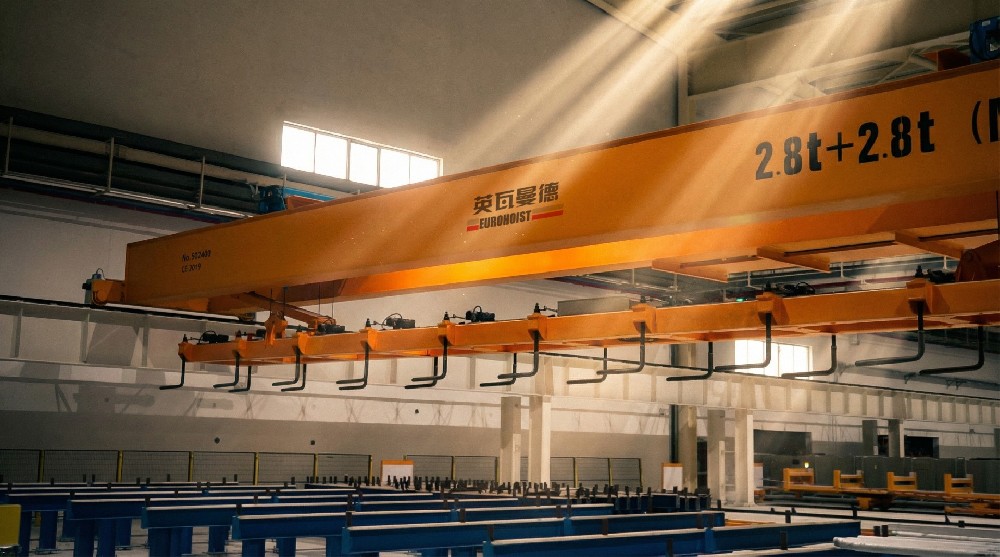
Large steel structure factory components, bridge steel box girders, and wind power tower tubes need to be frequently transferred between workshops and storage yards during production. Feeding of steel plates, transfer of semi-finished products after cutting, stacking of finished products after welding—the gantry crane is the main channel equipment for material flow on the entire production line.
The keywords for this scenario are high efficiency, low energy consumption, medium precision. The equipment operates 6-10 hours per day. Although it is not always at full load, the start-stop frequency is high and the cycle is tight. Therefore, smooth acceleration and deceleration with variable frequency drive (reducing impact and sway), lightweight structural design (reducing power consumption over time), and a simple and easy-to-use semi-automatic operation mode (reducing operator fatigue) are key points to focus on during procurement.
Scenario 2: High-speed rail beam yard and PC component factory
The precast production of high-speed rail box girders and building PC components has completely different requirements for gantry cranes: the number of lifts per day is not high, but each lift is almost a heavy-load operation close to the rated load of 200 tons. The span is usually 30-40 meters, and it needs to cover multiple precast pedestals and beam storage areas.
The most core performance indicator in this scenario is the precision of dual-lifting-point synchronous lifting. For a precast beam tens of meters long, both ends are lifted simultaneously by two overhead cranes or two lifting points of the same gantry crane—if the lifting speeds at both ends are not synchronized, even by a few tens of millimeters, torsional stress will be generated inside the beam body, and in severe cases may cause component cracking. In addition, under large-span conditions, the deflection deformation (deflection) of the main girder at full load must be strictly controlled within the design range.
Scenario 3: Large equipment final assembly workshop
Hydraulic turbine generator rotors, main bodies of mining crushers, shield machine cutterheads—the lifting requirements for these "big guys" in the final assembly workshop are completely different from those in steel structure storage yards. The number of lifts is not high, but each lift requires extremely high precision: when assembling large components, a bolt hole misalignment of 3-5 millimeters may prevent insertion; when turning components, if the lifted object sways, it may not only damage the workpiece but also pose a serious safety hazard.
This type of scenario has the highest requirements for the gantry crane's micro-movement positioning, anti-sway control, and operating response sensitivity. Some high-end scenarios even require the crane to have a "manual teaching + automatic playback" function—the operator manually guides the load along the positioning path once, the equipment records the trajectory, and automatically executes it in subsequent repetitive operations.
Scenario 4: Shipyard block assembly and heavy wharf
The 200-ton gantry crane at shipyards and heavy wharves faces the triple challenges of outdoor, high corrosion, and high working class. Ship hull blocks range from tens of tons to hundreds of tons, and the gantry crane must lift, turn, and precisely position them day after day in an open-air environment. Salt spray corrosion at the seaside will accelerate the aging of metal structures and electrical systems exponentially.
In this scenario, the structural anti-corrosion grade, electrical protection grade (at least IP65), reliability of wind-resistant anchoring devices, and durability design for A6-A7 high working class are the keys to determining whether the equipment can "withstand" the conditions.
3. Four core technologies of the EUROHOIST 200-ton gantry crane
EUROHOIST has 80 years of crane manufacturing experience, and has built a 30,000 square meter production and assembly base in Huzhou, China, with more than 500 employees worldwide and more than 60 technical personnel. Our products support light-duty and heavy-load handling, with rated specifications selected for the application. In the field of 200-ton gantry cranes, the following four capabilities are what we believe are most valuable to customers:
Technology 1: European-style lightweight structural design — reducing invisible costs
The self-weight of a traditional 200-ton gantry crane is usually between 200-250 tons. High self-weight means additional investment in three dimensions: first, the cross-section requirements and engineering volume of the track foundation (reinforced concrete strip foundation or pile foundation) are greater; second, the power level and daily power consumption of the travel motors are higher; third, the wear of the crane wheels and rails is faster.
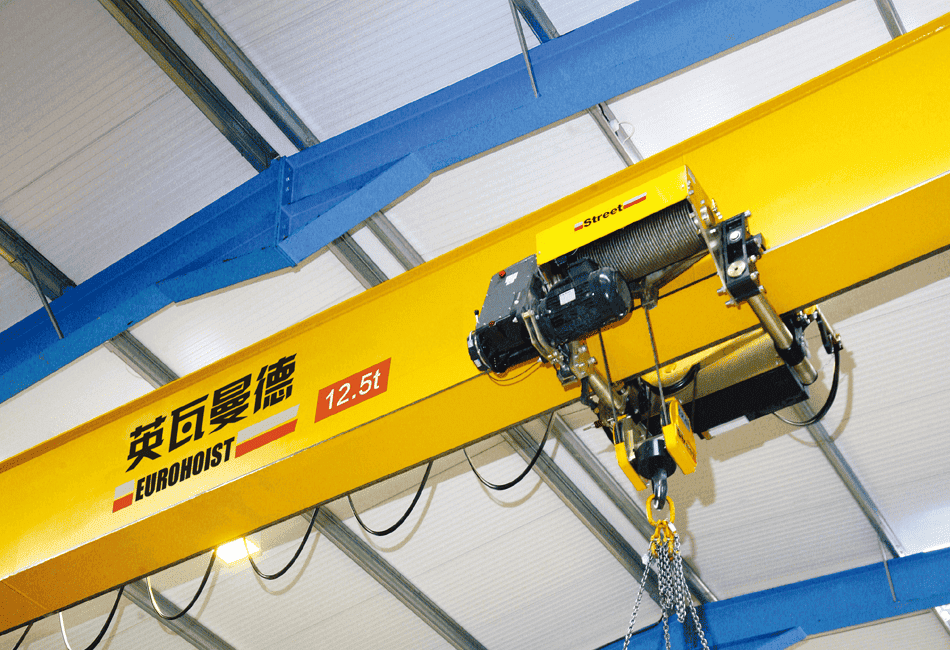
EUROHOIST adopts a Q355-B high-strength steel box girder structure and a compact transmission layout design. The overall self-weight can be reduced by 15%-20% compared with traditional solutions. This may look like just a percentage number, but when converted into an actual project it means: reduced foundation engineering volume, shortened civil construction period, and lower long-term electricity costs — these hidden cost savings are often easily overlooked when looking only at equipment quotations, but in reality have a huge impact.
Technology 2: High-precision anti-sway and dual-hoist synchronous control
During acceleration and deceleration of a gantry crane, the suspended load will naturally swing due to inertia. The larger the tonnage, the higher the lifting height, and the faster the travel speed, the more severe the swing. If a 200-ton gantry crane lacks effective anti-sway control, the swing amplitude of the load during operation may reach several meters — this is a serious constraint on operational safety, positioning accuracy, and work efficiency.
Closed-loop anti-sway control monitors the load angle and adjusts bridge and trolley acceleration to help reduce load swing, improve positioning and shorten waiting time. For multi-point lifting of prefabricated components, project-specific synchronized control helps coordinate the lifting points and reduce torsional risk. Anti-sway, positioning and synchronization performance must be verified for the load, lifting attachments and site conditions.
Technology 3: Progressive intelligent control from semi-automatic to fully automatic
Not every factory needs "fully automatic unmanned operation" right from the start, nor is every factory's digital infrastructure ready for fully automatic operation. EUROHOIST's 200-ton gantry crane supports progressive intelligent control upgrades from manual, semi-automatic to fully automatic:
Manual assist mode: anti-sway + precise positioning assist the operator, reducing the requirements for operator experience, so that even beginners can safely and accurately complete positioning
Semi-automatic mode: preset common transport paths and discharge positions. The operator triggers with one key, and the equipment automatically completes path planning and operation. The operator only needs to confirm key nodes
Fully automatic mode: the PLC fully automatic control platform supports mainstream industrial protocols such as Profinet/EtherNet/IP/Modbus TCP, enabling command-level integration with the factory WMS/MES system — the system issues "take material X from Area A and deliver it to workstation B," and the gantry crane completes the entire process autonomously
The core value of this progressive design approach is: today you can first use semi-automatic mode to lower the operating threshold and improve efficiency; tomorrow, after the factory's digital infrastructure is upgraded, the same equipment can be seamlessly upgraded to fully automatic mode without replacing the entire machine.
Technology 4: Cross-industry engineering experience — not just standard products
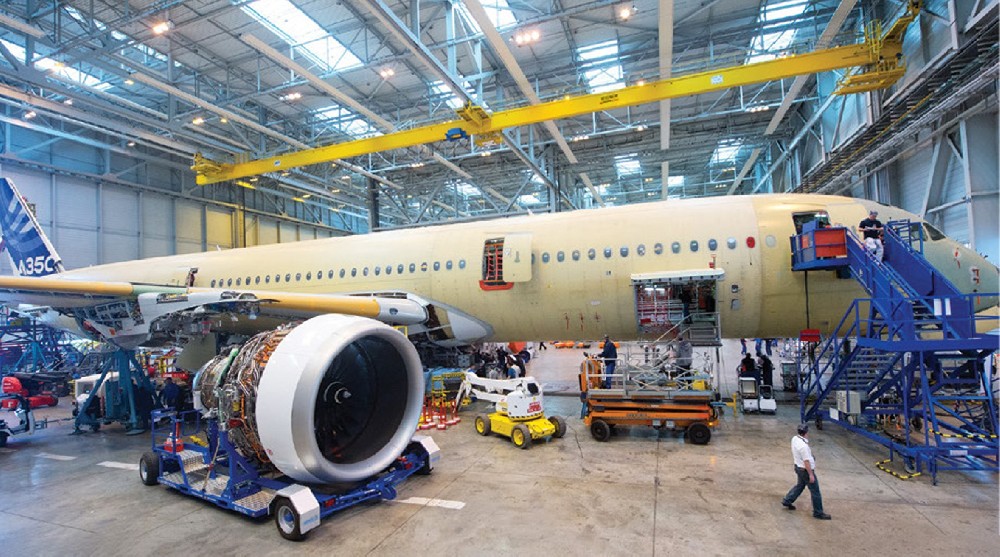
One of the biggest risks of a 200-ton gantry crane is that "the manufacturer has only made standard products in a certain industry and has no experience when encountering your non-standard requirements." EUROHOIST has accumulated a large number of customized solutions and engineering experience in more than ten industries, including papermaking (over 50 years of industry experience), aviation manufacturing, automotive stamping, power and energy, and steel and aluminum.
When a project requires an unusual span, limited headroom, a special connection to an existing building, custom lifting attachments (such as lifting magnets, C-hooks or rotating attachments), or special corrosion or explosion protection, our engineering team draws on experience across industries. Your project does not become a first-time experiment.
IV. Six-step method for selecting a 200-ton gantry crane
Purchasing a 200-ton gantry crane is not selecting a standard piece of equipment — it is a combination of a series of technical decisions. The following six steps can help you clarify your needs before contacting manufacturers:
Step | Decision content | Key questions |
| 01 | Determine the use scenario | Will your 200-ton gantry crane be used in steel structure processing, prefabricated components, equipment final assembly, or outdoor docks/shipyards? |
| 02 | Determine the working class | Average daily usage time? Full-load ratio? — A5 (intermittent medium duty), A6 (frequent medium-heavy duty), or A7 (continuous heavy duty)? |
| 03 | Determine the key parameters | Lifting capacity (single lifting point 200T or double lifting points 100T each for a 200T tandem lift?), span (m), lifting height (m), travel speed requirements |
| 04 | Determine the structural form | Box girder (high rigidity, high precision) or truss girder (light self-weight, good wind resistance)? European-style lightweight or traditional structure? |
| 05 | Determine the automation level | Purely manual, semi-automatic assistance, or full automation system integration? Should interfaces for future automation upgrades be reserved? |
| 06 | Determine the scope of supply | Does the manufacturer provide foundation design and rail installation guidance? Is the electrical system included? Are installation, commissioning, and training provided? |
Once this table is filled out clearly, technical discussions with manufacturers will be much more efficient—because different manufacturers receive a requirements specification that "speaks the same language," rather than each interpreting it in their own way when quoting a solution.
V. Frequently Asked Questions (FAQ)
Q1: For a 200-ton gantry crane, should a box girder or a truss girder be chosen?
A box girder structure is made of steel plates welded into a closed box, offering high rigidity, high manufacturing precision, and smooth travel, making it suitable for indoor or low-wind-load scenarios that require running stability and positioning accuracy. A truss girder is made of structural steel connected by welded or bolted joints, with lighter self-weight (15%-20% lighter than a box girder of equal load capacity) and better wind resistance, making it suitable for large-span outdoor use or coastal areas with greater wind loads. The cost difference between the two is not significant—which one to choose mainly depends on the basic wind pressure in your area and how high your requirements are for rigidity/precision.
Q2: What are the installation precision requirements of a 200-ton gantry crane for the crane runway rails?
This is where many projects run into the most problems. The three key indicators for rail installation: first, the straightness of the rail (the bending deviation in the horizontal plane is generally required not to exceed ±3mm/2m); second, the elevation deviation of the rails (the height difference between the two rails at corresponding positions is generally required not to exceed ±5-10mm, depending on the span); third, the misalignment and gap at rail joints (generally required not to exceed 1-2mm). If rail installation does not meet the standard, the gantry crane will "rail-gnaw" during operation—abnormal wear of the wheel flanges, loud running noise, and even derailment in severe cases. It is recommended that rail installation be calibrated section by section by an experienced surveying team using a total station.
Q3: Is the daily maintenance workload of a 200-ton gantry crane heavy?
With normal use and maintenance practices, the daily maintenance of a 200-ton gantry crane is not complicated. The most critical routine items are: regular inspection of the wire rope (broken wires, wear, lubrication condition), wear inspection of the wheel flanges of the trolley and bridge wheels (to determine whether "rail-gnawing" is occurring), verification of the brake torque, cleaning of the electrical control cabinet and tightening of wiring, and regular testing of the wind-resistant anchoring device. If the equipment is equipped with a fault self-diagnosis system, many hidden issues can be warned about before they escalate. For core drive components (such as the SEW geared motors selected by EUROHOIST), with proper sealing and lubrication, 10 years of operation without disassembly is normal.
Q4: What is the service life of a 200-ton gantry crane? What is the biggest factor affecting its life?
The design life is usually 20-25 years. The biggest factors affecting actual life, in order of importance, are: Frequency of use(overload use far exceeding the design duty class will accelerate metal fatigue), Anti-corrosion maintenance(regular inspection and repair of anti-corrosion coatings on outdoor equipment determines the structural life), Rail installation quality(damage to the wheels and bridge drive system from wheel-flange rubbing against the rails accumulates continuously), Operating discipline(frequent emergency stops, overloads, and side-pulling will multiply structural stress). A well-maintained gantry crane remains structurally safe and usable after 20 years of operation; one that is neglected may require major overhaul in 10 years.
Q5: From order placement to production startup, how long is the entire cycle?
For a custom 200-ton gantry crane, from contract signing to being ready for production, it usually takes 4-8 months. The time allocation is roughly as follows: detailed design and drawing production 1-2 months, manufacturing and welding of large structural components such as the main girder and legs 2-3 months, assembly and in-plant commissioning of the electrical system 1 month, track foundation construction carried out in parallel over 1-2 months (depending on civil works conditions), on-site installation and whole-machine commissioning 1-2 months. If your project schedule is relatively tight, you can start the civil design and construction of the track foundation before the contract is signed—this part of the work can proceed in parallel with the equipment manufacturing cycle.
Q6: If the factory plans to implement an MES/WMS system in the future, will the gantry crane purchased now be compatible?
Compatibility depends on the gantry crane's electrical architecture. If its control system is designed from the outset with standard industrial protocols (Profinet/EtherNet/IP/Modbus TCP) and open interfaces, later MES/WMS integration requires software interface development, integration and commissioning without hardware changes. Closed control systems with non-standard protocols and inaccessible data interfaces are more difficult and costly to retrofit. Ask the manufacturer for a detailed electrical architecture diagram and communication interface specifications, and include these requirements in the contract's technical annex.
EUROHOIST
80 years of crane manufacturing experience | Specialists in intelligent industrial lifting solutions
China production and assembly base: Huzhou High-tech Zone, Zhejiang | Factory area: 30,000 square meters
Product range: Light-duty and heavy-load handling, configured for the application | Fully automatic cranes | Overhead cranes | Gantry cranes | Portal slewing cranes | Explosion-proof cranes | Cleanroom cranes | Various electric hoists and lifting mechanisms
Service fields: Steel structure processing | Prefabricated components | Equipment manufacturing | Shipbuilding and docks | Steel and aluminum industry | Power and energy | Paper industry | Automotive manufacturing | Aerospace | Railway transportation
Global partners: China National Building Material | Sinoma International | GE | Alstom | Hyundai (Korea) | Emirates Global Aluminium
Official website: www.EUROHOIST.com.cn