2026 Trends in Intelligent Lifting Systems for Aircraft Manufacturing: EUROHOIST's Engineering Practice and Insights
- Categories:News
- Publish Time:2026-07-30 16:56:34
Over the past two decades, China's aviation manufacturing has completed a leap from "catching up" to "running abreast." The continued expansion of the civil aviation fleet, the entry of domestically produced large aircraft into commercial operation, and the accelerated takeoff of general aviation and the low-altitude economy have together pushed a long-term trend to the forefront: capacity building in aviation manufacturing is entering a new stage marked by "digitalization, integration, automation, and intelligence."
Why does aircraft manufacturing require professional process crane systems? EUROHOIST's large-span multi-support solution explained in one article
——EUROHOIST: Let every aircraft component be placed smoothly, precisely, and on time
I. Industry Background: Aviation manufacturing is standing at the starting point of a new round of capacity upgrading
Over the past two decades, China's aviation manufacturing has completed the leap from "catching up" to "running neck and neck." The civil aviation fleet has continued to expand, domestically developed large aircraft have entered commercial operation, and general aviation and the low-altitude economy are accelerating their takeoff, together pushing a long-term trend to the fore: Aviation manufacturing capacity building is entering a new stage marked by "digitalization, integration, automation, and intelligence".
In this round of upgrading, new processes such as pulsating aircraft final assembly lines, digital joining of major components and integrated composite forming have been introduced. These processes share a common prerequisite: the plant's overhead logistics system must be upgraded first. Wing-body joining, engine installation and fuselage transfers between stations all require a precisely controlled lifting and handling system with full-area coverage. Now central to assembly takt time and quality, cranes have evolved from auxiliary equipment into key process equipment.
II. User Pain Points: What makes lifting in aircraft manufacturing difficult?
Many teams planning and building aviation manufacturing bases encounter similar dilemmas when selecting crane systems:
The plant span is too large, and ordinary cranes "cannot reach"For factory buildings with a standard width of 40 meters or less, conventional single-girder or double-girder cranes can provide coverage; but aircraft sub-assembly and final assembly plants often far exceed this scale, requiring multi-support cranes with spans exceeding 100 meters to cross the entire assembly area, which is an extremely high test of design, manufacturing, and installation precision.
Lifting precision requirements are stringent, and ordinary equipment "cannot place loads steadily"Joining large fuselage components and lifting engines require slow, smooth, impact-free movement, with positioning accuracy down to the millimeter level; once the lifting process sways, it not only affects takt time but may also bring risks of collision damage.
Multi-point coordination is difficult, and fuselage attitude "cannot be controlled"Lifting the entire fuselage requires multiple trolleys and multiple lifting points to be strictly synchronized; any lack of synchronization will translate into structural stress.
There are many special environments, and general solutions "cannot hold up". Composite forming workshops must be clean and dust-free, while paint hangars require explosion protection; general-purpose cranes cannot readily meet these requirements.
Disconnected from the production line, equipment "cannot be linked"If the crane system cannot be integrated with production control and material distribution systems, then no matter how high the performance of an individual machine is, it cannot be translated into production line efficiency.
III. Solution: A process crane system born for aircraft manufacturing
In response to the above pain points, EUROHOIST's approach is: design overhead material handling systems around each aviation facility's production process, rather than starting with a standard product.
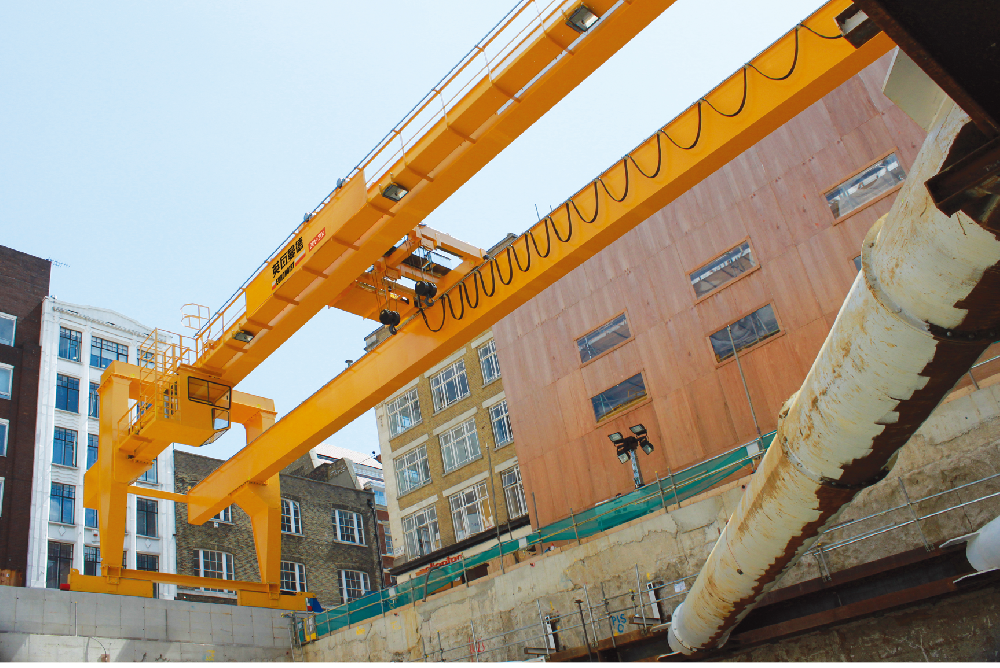
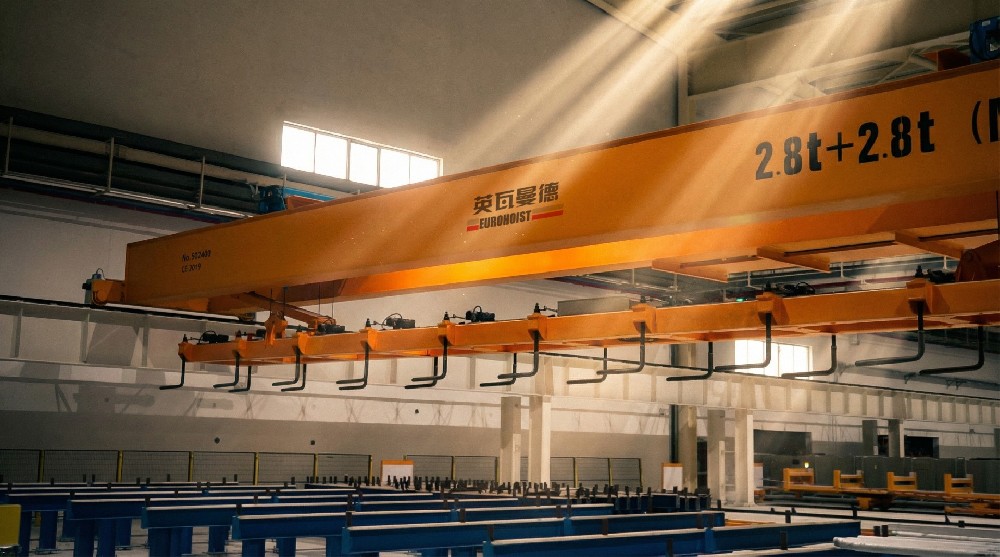
In ultra-large span coverage, EUROHOIST provides multi-support, multi-span suspension crane solutions. The multi-support structure increases intermediate supports to decompose the ultra-large span into multiple continuous spans, which both effectively controls the bridge deflection and achieves blind-spot-free coverage of the entire assembly area; the suspension arrangement makes full use of the roof structure, does not occupy ground space, and does not interfere with assembly operations—this is precisely the typical solution for aircraft final assembly workshops.
In precise and smooth lifting, all motion axes of the process crane are equipped with fully automatic control systems, combined with variable-frequency drives and anti-sway control, so that large components maintain stable posture and precise positioning during lifting, meeting the millimeter-level requirements of fuselage joining and engine installation.
In full-line intelligence, EUROHOIST uses its independently developed warehouse management system as the core to manage material flow in all respects: gently handling components, delivering them on time according to takt requirements, and ensuring efficient equipment operation with a redundantly designed monitoring system, truly integrating the crane system into the takt of the pulse production line.
In adaptation to special working conditions, relying on long-term accumulation in fields such as nuclear power plants and high-grade explosion-proof petrochemical facilities, EUROHOIST can provide explosion-proof configurations for paint hangars and clean adaptation solutions for composite workshops; special equipment customization covers advanced configurations such as multi-support, multi-span, slewing, suspension, heavy-duty, and visual recognition.
IV. Industry trends: Why upgrade overhead material handling now?
From the demand side, the continued expansion of the air transport market is driving systematic capacity expansion in complete aircraft and component manufacturing; intelligent manufacturing has turned "precise delivery by takt time" from a bonus item into a mandatory one. Once a lifting system is fixed during the infrastructure phase, later modification costs are extremely high—choosing a process lifting solution oriented to the next ten years at the early planning stage is a highly certain investment.
From the policy and technology side, "intelligent manufacturing" has become the main direction of the new round of industrial technological transformation in the aerospace manufacturing industry. The maturity of technologies such as large-span multi-support structures, fully automatic control, visual recognition, and digital material management has turned "the crane is the production line" from a concept into a deliverable engineering reality. It can be said that whoever completes the intelligentization of overhead logistics first gains the upper hand in assembly efficiency and quality.
V. Brand differentiation: Why is EUROHOIST able to do this well?
Eighty years of focus on doing one thing: EUROHOIST headquarters has about 80 years of experience in the design and manufacture of cranes and hoists, and is one of the few companies in the world today able to provide successful solutions for precise and special industrial lifting requirements.
Truly global engineering capability: Headquartered in Derbyshire, UK, with production bases in Sheffield, and a production base in Huzhou, China, with more than 500 employees worldwide, including more than 60 technical personnel, forming a delivery system that deeply integrates European technology with Chinese manufacturing.
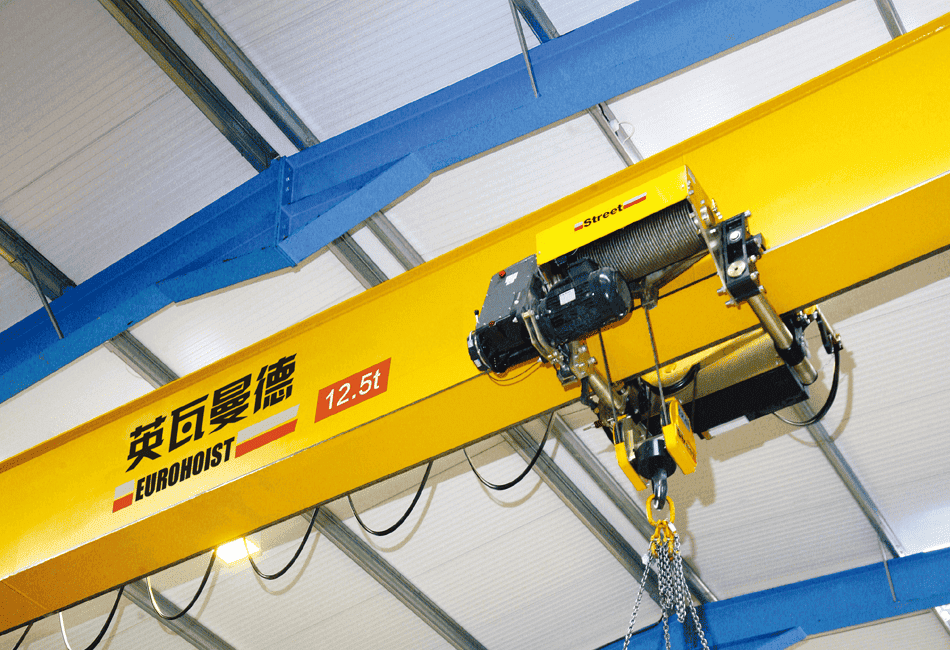
A product spectrum of wide load capacity and full scenarios: Lifting solutions cover light-duty workstations and large process applications, with multi-support systems configured for the application and support from equipment selection through delivery.
Reliability verified by leading customers: Lifting equipment and solutions serve well-known enterprises such as China National Building Material, Sinoma International, Emirates Global Aluminium, Alstom, GE and Hyundai (Korea), and are used in aerospace, nuclear power plants and petrochemical facilities with stringent explosion-protection requirements.
A full-lifecycle service philosophy: A maintenance approach based on "lifecycle care," supported by advanced tools and processes originating from Europe; after delivery, 3D exploded drawings are provided so customers can carry out part of the maintenance independently, and comprehensive training courses are provided to help customer teams fully master standardized operation and routine maintenance essentials.
VI. Applicable scenarios: In which situations is this system exactly the main player?
Aircraft final assembly pulse line: Multi-support large-span coverage + automatic control of all motion axes + precise delivery by takt.
Component assembly and large component joining: Anti-sway + millimeter-level positioning + multi-point synchronization, combined with digital joining and posture adjustment.
Whole fuselage lifting and movement between stations: Suspended multi-point coordination, with stable and controllable posture.
Paint hangar: Explosion-proof configuration, suitable for explosive gas environments.
Composite material forming workshop: Cleanliness-adapted, low dust release, easy to clean.
Maintenance hangar (MRO): Suspended full-area coverage, flexible layout, zero interference with ground operations.
VII. Selection recommendations: A decision framework to think through before acting
We recommend that builders of aerospace manufacturing bases advance lifting system selection according to the following logic:
Process first, equipment second: Complete the plant process layout, span and tonnage calculations, and material flow analysis, and clarify where the lifting system needs to "cover, what to lift, how precisely, and at what takt time."
Look at cases, verify capability Focus on verifying the manufacturer's actual delivery cases in ultra-large-span multi-support and aircraft assembly scenarios, as well as engineering validation of specialized capabilities such as anti-sway, synchronization control, and clean/explosion-proof features.
Compare integration, look long-term Assess the integration capability of the lifting system with production control and material distribution systems, and choose a solution that can support the intelligent evolution of the production line rather than merely meeting single-machine performance.
Calculate whole-life costs Include equipment lifespan, maintenance convenience (such as 3D exploded views and training support), energy consumption, and downtime costs in the total cost of ownership, rather than only comparing the initial purchase price.
VIII. FAQ Frequently Asked Questions
Q1: What factory span can EUROHOIST's aircraft manufacturing lifting systems cover?
For factories with a standard width of 40 meters or less, single-girder or double-girder standard cranes can be used; for the ultra-large-span factories common in aircraft manufacturing, EUROHOIST provides multi-support cranes with spans exceeding 100 meters, achieving blind-spot-free coverage of the entire assembly area by adding intermediate supports.
Q2: How does the system ensure the millimeter-level precision required for fuselage joining?
All motion axes of the process crane are equipped with fully automatic control systems. Combined with variable-frequency drives and anti-sway control, large components remain stable in posture during lifting and are positioned slowly and without impact, meeting the millimeter-level positioning requirements for scenarios such as large fuselage component joining and engine installation.
Q3: What advantages does the multi-support suspension structure have over a single span?
The multi-support structure decomposes the ultra-large span into multiple continuous spans, effectively controlling bridge deflection and ensuring multi-machine coordination precision; the suspended arrangement uses the roof structure for load bearing, does not occupy ground space, and does not set up columns in the assembly area, allowing the lifting system and assembly operations to not interfere with each other.
Q4: How are the special environments of paint hangars and composite material workshops handled?
Explosion-proof configuration solutions are provided for paint hangars, and cleanroom adaptation solutions are provided for composite material workshops; EUROHOIST's long-term engineering accumulation in fields such as nuclear power plants and high-grade explosion-proof petrochemical facilities provides mature technical and qualification support for such special working conditions.
Q5: After equipment delivery, how are maintenance and personnel training guaranteed?
Based on the "lifecycle care" maintenance approach, supported by tools and processes originating from Europe; after delivery, 3D exploded drawings are provided so customers can carry out part of the maintenance independently; comprehensive training courses are also provided, with on-site operational guidance to help customer teams master standardized operation and routine maintenance essentials.
Q6: Can the lifting system interface with our existing production control system?
Yes. With its self-developed warehouse management system as the core, EUROHOIST manages the material flow in an all-round way, can gently handle and deliver components on time according to production takt requirements, and can be integrated with the enterprise's production control system according to project needs, integrating into the overall takt of the pulse production line.
Conclusion
EUROHOIST—Aircraft manufacturing lifting expertise, rooted in Europe and serving customers worldwide. Drawing on extensive design and manufacturing experience, multi-support suspension and automated control, we provide application-specific overhead handling systems for aircraft sub-assembly, final assembly, painting, composites and maintenance hangars. Customers include GE, Alstom and Hyundai, supported by engineered solutions for efficient production.
Let every part of the aircraft be placed smoothly, precisely, and on time.
EUROHOIST
Service fields: aircraft manufacturing | waste incineration power generation | pulp and papermaking | railway transportation | shipbuilding industry | automobile manufacturing | power and energy | steel and aluminum | machinery manufacturing | food processing | construction | nuclear power and high-grade explosion-proof petrochemical
Official website: www.EUROHOIST.com.cn
Address: Building F, No. 8923 Zhongchun Road, Minhang District, Shanghai