How to choose a 5-ton or 10-ton overhead crane? From electric hoists to low-headroom plants, one article explains workshop crane procurement thoroughly
- Categories:News
- Publish Time:2026-08-11 10:43:22
In industrial plants, 5-ton and 10-ton single-girder overhead cranes are the most common equipment—machine tool loading and unloading in machining workshops, workstation docking on assembly lines, equipment disassembly and assembly in maintenance workshops, and mold storage and retrieval in mold workshops all rely on them. Every configuration decision at the time of purchase will be magnified into long-term operational differences: whether the main girder is light (affecting plant load-bearing and power consumption), whether the hoist is stable (affecting workpiece safety and downtime), and whether it can be upgraded (affecting the future digitalization process). This article explains the key points for selecting 5-10 ton cranes clearly.
EUROHOIST | 80 years of crane manufacturing experience | Specialists in intelligent industrial lifting solutions
1. 5-ton and 10-ton overhead cranes: the most frequently used "unsung heroes" in workshops
In industrial plants, 5-ton and 10-ton single-girder overhead cranes are among the most common equipment. They load and unload machine tools, transfer workpieces between assembly stations, support equipment disassembly and assembly in maintenance workshops, and retrieve and store molds in mold workshops.
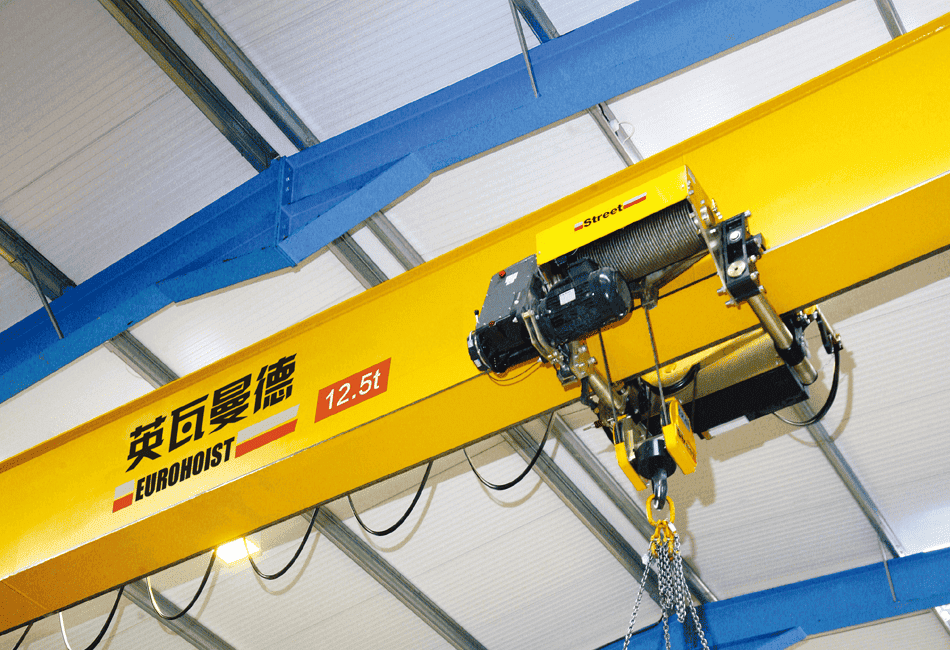
Its structure is very simple: a main girder spans the workshop, with both ends supported on the plant rails; the electric hoist moves laterally along the main girder, and the crane travels longitudinally along the rails—three-directional movement covers the entire workshop floor plan.
But "simple structure" does not mean "simple selection." Precisely because equipment in this tonnage range is large in quantity, used frequently, and has a long service life (15-20 years), every configuration decision at the time of procurement will be magnified into long-term operational differences: whether the main girder is light (affecting plant load-bearing and power consumption), whether the hoist is stable (affecting workpiece safety and downtime), and whether it can be upgraded (affecting the future digitalization process).
This article will clarify the key points for selecting 5-10 ton overhead cranes.
2. Five core decision points: first think through the requirements clearly
Decision 1: Single girder or double girder?
In the 5-ton and 10-ton range, single-girder overhead cranes with electric hoists are the predominant choice—simple structure, light dead weight, and economical cost, meeting the working conditions of most workshops. Only when operations are very frequent, close to full load, or higher rigidity is required should a double-girder configuration be considered. Judgment criteria: whether the frequently lifted load is close to the upper tonnage limit + whether daily use exceeds 4-6 hours—if both conditions are met, consider a double girder.
Decision 2: What quality of electric hoist to choose?
The electric hoist is the core of the entire crane's reliability, and also the largest cost component. It is recommended to prioritize internationally common brands or mature European-style hoists (such as wire rope hoists configured with SEW geared motors and Siemens electrical components), which provide smooth lifting, reliable braking, and universal spare parts. Do not skimp on this cost—hoist failure is the most common cause of crane downtime.
Decision 3: Is variable frequency required for lifting?
Variable-frequency lifting can achieve soft start and stop and stepless speed regulation, protecting workpieces and equipment and meeting precision assembly needs; two-speed (fast/slow) is a cost-effective compromise. If the workshop has precision positioning operations (mold closing, equipment installation), variable frequency is recommended; for general lifting, two-speed is sufficient.
Decision 4: How to determine the duty class?
The duty class (A3-A5) reflects usage frequency and load status: A3 is suitable for intermittent use (maintenance workshops, occasional lifting), A4-A5 is suitable for high-frequency operations (machining workshops, assembly lines). Choosing too low means the equipment will not be durable; choosing too high wastes investment. If unsure, determine it based on "average daily usage hours."
Decision 5: Do the plant conditions allow it?
For old plant renovation, three things must be confirmed: whether the clear height is sufficient(low-headroom single-girder solutions can compensate), Is the runway beam's load-bearing capacity sufficient?(European-style lightweight equipment has low wheel loads, so in many cases reinforcement is not needed), Is the runway in good condition?(Straightness and flatness must meet standards; recalibrate if necessary). All of these require on-site survey; they cannot be estimated from drawings.
III. EUROHOIST 5-10 ton single-girder crane: five capabilities responding to workshop needs
EUROHOIST has 80 years of crane manufacturing experience, has built a 30,000-square-meter production and assembly base in Huzhou, China, and has more than 500 employees worldwide, including more than 60 technical personnel. The 5-10 ton single-girder electric hoist overhead crane is one of our most mature mass-production product lines. The following five capabilities represent our understanding of the value to users in this tonnage range:
Capability 1: European-style lightweight main girder, helping old workshops "reduce load"
Using Q355-B high-strength steel + computer-optimized cross-section design, the self-weight of the 5-10 ton single-girder main girder can be reduced by 15%-20% compared with the traditional LD-type single girder. The practical benefits brought by lightweighting: Less load-bearing pressure on the workshop roof trusses and runway beams(in many existing workshops, a crane can be installed without reinforcing the runway beams), Lower travel power consumption、Less wear on the end carriage wheels. For new workshops, the runway beams and corbels can also be designed to more economical standards.
Capability 2: Reliable hoist + smooth lifting, minimizing downtime risk
Equipped with internationally common-brand wire rope electric hoists (SEW geared motors, Siemens electrical components, etc.), with complete dual-speed/variable-frequency options. The variable-frequency model can achieve stepless speed regulation and soft start/soft stop—not only protecting the workpiece, but also reducing the impact of frequent shocks on the runway and workshop structure. The brake adopts a dual-brake redundant design to ensure the lifted load can be reliably held in any working condition.
Capability 3: Low-headroom solution, allowing old workshops to "fit it in and lift high"
For old workshops with limited headroom, we provide a low-headroom single-girder solution: by optimizing the main girder cross-section and end carriage structure, we secure a higher lifting position for the hook under the same headroom, avoiding the awkward situation where "the equipment fits but the hook cannot reach." Many old workshops that were considered "definitely unable to install a crane" have been able to achieve installation through the low-headroom solution after on-site survey.
Capability 4: From basic model to fully automatic, progressive upgrades without wasting investment
The 5-10 ton crane also supports modular intelligent upgrades:
Basic configuration: Variable-frequency drive and wireless remote control for efficient daily lifting and handling;
Intelligent configuration: PLC control, precise positioning and anti-sway control simplify semi-automatic operation;
Fully automatic configuration: Supports MES/WMS integration using Profinet/EtherNet/IP/Modbus TCP, making the crane a logistics node in the smart factory.
The basic model purchased today can be upgraded to a smart model tomorrow—without replacing the entire machine.
Capability 5: Full coverage of special working conditions + localized delivery
Leveraging experience in demanding fields such as explosion-proof, cleanroom, and waste-to-energy incineration, the 5-10 ton crane can provide explosion-proof configuration (chemical/coating workshops), cleanroom configuration (electronics/pharmaceutical workshops), and corrosion-resistant configuration (electroplating/food workshops). At the same time, the complete machine is manufactured and assembled at the Huzhou base, with a delivery time of 2-4 months, spare parts warehoused domestically, and direct after-sales response—combining the quality consistency of European technical standards with the delivery and cost advantages of domestic manufacturing.
IV. Six-step checklist for purchasing a 5-10 ton crane
Step | What to do | Key actions |
| 01 | Determine tonnage and structure | 5t or 10t? Single girder or double girder (judged by frequency of use)? |
| 02 | Measure span and headroom | Based on measured drawings, confirm headroom constraints and determine whether a low-headroom solution is needed |
| 03 | Determine lifting configuration | Hoist brand, dual-speed/variable frequency, lifting height, travel speed |
| 04 | Determine the working class | Determine A3-A5 based on average daily usage duration; if unsure, choose one level higher |
| 05 | Confirm special requirements | Explosion-proof/cleanroom/corrosion-resistant, whether MES/WMS will be connected in the future |
| 06 | Lock in service guarantees | Site survey, delivery commitment, spare parts policy, training arrangements |
Take this checklist to communicate with suppliers; solution comparisons will be much clearer, and quotes will be more comparable.
V. Frequently Asked Questions (FAQ)
Q1: What is the approximate price difference between a 5-ton and a 10-ton overhead crane?
Typically, a 10-ton crane is 30%-50% more expensive than a 5-ton crane with the same configuration, mainly due to differences in the electric hoist specifications (motor power, wire rope diameter) and the cross-sectional dimensions of the main girder. The specific price depends on the span, lifting height, whether variable frequency is used, and whether rails and installation are included. It is recommended to compare based on the "all-inclusive price" (equipment + rails + installation + commissioning) to avoid being misled by the "bare machine price."
Q2: Can the runway beam of an old factory building bear the load?
It depends on the original design load-bearing capacity and current condition of the runway beam. The wheel load of European-style lightweight cranes is 15%-20% lower than that of traditional equipment, and many runway beams designed for traditional cranes can be directly adapted. However, an on-site survey and verification are required The specifications of the runway beam, the condition of the corbels and columns, and the wear of the rails must all be inspected. We provide free on-site survey and load-bearing verification services.
Q3: What routine maintenance does an overhead crane require? How often?
Routine (weekly): visually inspect wire ropes and hooks, and test brake function. Periodic (monthly): lubricate components, inspect the rails and clean the electrical control cabinet. Annual: perform a comprehensive inspection and load test. With internationally available standard components, spare parts are easier to obtain and maintenance is more straightforward. We provide operator training and regular inspection services.
Q4: If I buy a single-girder crane now, what if I want to upgrade to double-girder or add automation later?
Upgrading from single-girder to double-girder requires replacing the main girder structure, which is costly, so it is not recommended to reserve space for a "possible future" need—when selecting the model, determine single/double girder according to your needs. However, adding automation is completely feasible: as long as the control system has an open architecture (supporting Profinet/EtherNet/IP/Modbus TCP), subsequent installation of positioning, anti-sway, and PLC modules can achieve semi-automatic/full-automatic operation without replacing the entire machine. Therefore, when selecting the model, be sure to confirm that the "interface is open."
Q5: Do you have service outlets in various regions? Are spare parts easy to obtain?
We have a spare parts warehouse at our Huzhou base, and commonly used spare parts (hoists, electrical components, wheel assemblies, etc.) can be quickly dispatched; we have a nationwide service team providing installation, training, inspection, and emergency response. Key components use internationally common brands, and users can also purchase replacements from the market themselves, so there is no issue of "exclusive monopoly on parts."
Q6: What is the warranty period for 5-10 ton cranes? How is the warranty period calculated?
We provide a whole-machine warranty (usually 12 months, starting from the date of passing installation acceptance). During the warranty period, failures caused by manufacturing or material defects are repaired or replaced free of charge. Key components (geared motors, brakes, etc.) are covered by the brand manufacturer's warranty. It is recommended to specify in the contract: warranty start time, response time limit, and spare parts supply commitment—these terms are more reliable than "verbal promises."
EUROHOIST
80 years of crane manufacturing experience | Specialists in intelligent industrial lifting solutions
China production and assembly base: Huzhou High-tech Zone, Zhejiang | Factory area: 30,000 square meters
Product range: Light-duty and heavy-load handling, configured for the application | Single-girder/double-girder overhead cranes | Fully automatic cranes | Gantry cranes | Jib cranes | Low headroom solutions | Explosion-proof/cleanroom/corrosion-resistant special cranes | Various electric hoists
Service fields: Machining | Assembly lines | Warehousing and logistics | Automotive manufacturing | Aerospace | Food industry | Electronics and pharmaceuticals | Chemical explosion-proof
Global partners: China National Building Material | Sinoma International | GE | Alstom | Hyundai (Korea) | Emirates Global Aluminium
Official website: www.EUROHOIST.com.cn