
EUROHOIST
Precise and efficient aviation handling solutions
Lifting solutions for the aviation manufacturing field
In the aviation industry, EUROHOIST aircraft manufacturing cranes play a key role in component handling at aircraft plants, and our suspension cranes are used for the assembly of various components and the lifting and transport of entire fuselages.
Lifting equipment plays a huge role in global aircraft manufacturing and maintenance. Cranes are not only used in component manufacturing processes, but also for handling aircraft wing panels, engines, and other components within the workshop, and even entire fuselages. As an overhead handling system covering the entire area, cranes connect each assembly stage, and the more closely their design is tailored to a specific process, the more production costs are reduced.
EUROHOIST's fully automatic lifting solutions can greatly reduce plant construction costs. Their compact design, low headroom, small side hook approach dimensions and short operating cycles (PLC-controlled fully automatic and semi-automatic cranes) help customers reduce capital expenditure and improve productivity.
Over eighty years of global crane experience
EUROHOIST originated in Europe and serves the world. Its headquarters has 80 years of experience in the design and manufacture of cranes and hoists, providing global customers with better products and services.
Our experience in designing and manufacturing efficient material handling solutions has earned our cranes a strong reputation in the aircraft manufacturing industry.
With its crane experience and focus on product research and development, EUROHOIST has become synonymous with quality and innovation in the aviation manufacturing field.
EUROHOIST's success lies in long-term investment in research and development. Under this philosophy, we set new benchmarks, solely for efficient performance and operational reliability.
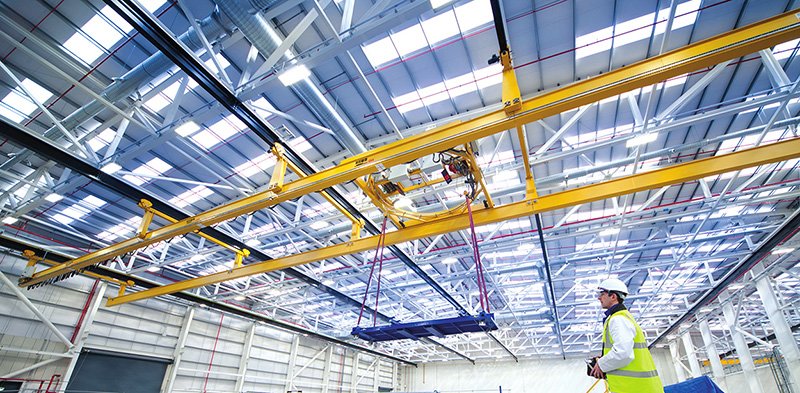
Fully automatic cranes tailored specifically for aircraft manufacturing
The type of crane varies greatly depending on different building structures. For standard workshops with a width of 40 meters or less, standard single-span cranes with single-girder or double-girder structures can be used.
Aircraft manufacturing plants are much larger than typical manufacturing workshops and therefore require much larger crane spans. These environments require multi-support intelligent or fully automatic overhead cranes with spans exceeding 100 meters.
EUROHOIST has always been able to provide corresponding solutions in special structures, integrated handling, extreme working temperatures and loads, special controls, automation, and specially designed safety equipment and systems.
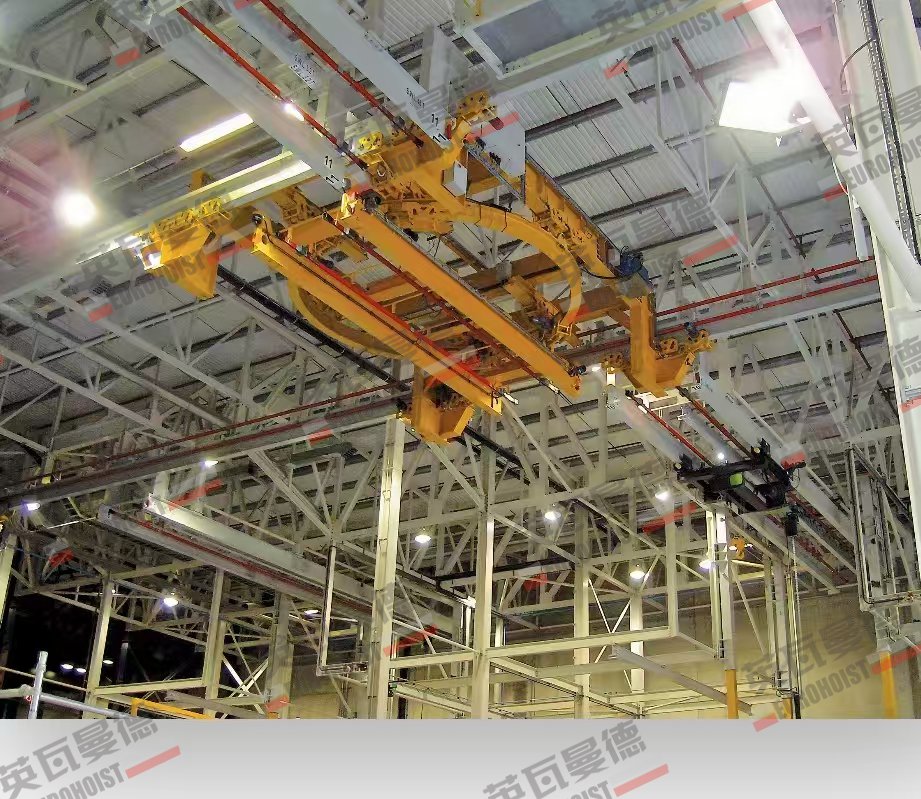
Core advantages of fully automatic aircraft manufacturing cranes
Super-large span multi-support design— Aircraft manufacturing plants have large spans, and cranes can adopt multi-support overhead crane structures with spans exceeding 100 meters, perfectly adapting to large aviation manufacturing plants
Fully automatic control system— Semi-automatic and fully automatic cranes use PLC control to ensure shorter working cycles; target positioning prevents the inefficiency of manual control, with an electronic anti-sway system
All-axis automatic drive— All motion axes of process cranes are equipped with fully automatic control systems
Extreme precision positioning— With displacement measurement systems on each axis, up to 1000 measurement positions can be stored, resulting in extremely precise positioning
Efficient and safe handling— For stages requiring repeated gripping, handling, and placing of components, the process can be accelerated and safety improved
Intelligent warehouse management— A self-developed warehouse management system provides comprehensive warehouse management
Gentle handling technology— Handle components gently and deliver them to the required positions in time with the production cycle, protecting precision aircraft components from damage
Lower overall costs— Through automation, continuous stacking and storage processes can be managed mechanically, significantly reducing the risk of accidents while improving precision and efficiency